Revision
How to know if your child is actually revising (not just holding the phone)
Every parent knows the scene: door closed, phone in hand, “I’m revising.” Sometimes it’s true. Here’s how to tell — kindly — when it isn’t.
Last updated: 6 September 2026
How do I know if my child is really revising? Look for three things over a few weeks: a short teach-back (“explain what you revised”), one artifact (notes, practice, a quiz score), and movement on a named topic — not just hours with a phone in hand.
Why “umesoma?” doesn’t work
The nightly interrogation has a design flaw: it can only ever collect one answer. “Yes.” A child who studied for two focused hours says yes; a child who watched videos for two hours says yes. The question isn’t dishonest — it’s unanswerable. Time with a book open, or a phone in hand, simply isn’t evidence of learning either way.
It also puts the child in an impossible position. Answering honestly with “not really, I got distracted” invites a scolding, so the incentive quietly runs the other way — toward a confident “yes” regardless of what actually happened behind the closed door. A better question doesn’t ask for a report on effort; it asks for evidence of it.
None of this means most Kenyan teenagers are lying to their parents most nights. Many genuinely are revising, and many are somewhere in between — starting with real intent, then drifting after ten focused minutes once the door is closed. The point isn’t to assume the worst. It’s to replace an unanswerable question with a system that can tell the difference, kindly.
Time on the phone vs evidence of learning
| What the parent hears / sees | What the parent actually knows | Trust effect |
|---|---|---|
| “I was on the phone for two hours” / Screen Time says 2 hrs | Duration only — could be practice or videos | Invites suspicion by default |
| 38 minutes on decimals · quiz 42% → 68% · named topic | Subject, effort shape, and movement | Invites trust — the record either exists or it doesn’t |
Hours are not evidence. Named topic + attempt + improvement is.
The signs of real revision
- They can explain it back. “Teach me the thing you revised” for two minutes tells you more than an hour of supervision. Confusion isn’t failure — it’s information.
- Something gets produced. Worked examples, practice answers, quiz scores. Reading without producing anything is the weakest form of study.
- The same topics don’t stay “hard” forever. If fractions are the excuse in Week 2 and still the excuse in Week 8, revision isn’t happening — avoidance is.
- Effort shows up in results, eventually. Not overnight. Real weekly revision shows a visible climb within a few weeks.
None of these require snooping through a phone. They come from a short, respectful conversation — which is why the weekly ritual below beats daily suspicion.
The 5-minute weekly check ritual
You don’t need a nightly audit. A short Sunday-evening ritual, done consistently, tells you more:
- Look at one produced artifact. Practice answers, notes, or a quiz score. One real object.
- Ask for a two-minute teach-back. “Teach me the thing you’re most sure about from this week.” Listen without correcting.
- Ask one kind, specific question. Not “did you revise?” — “what was the hardest question this week?”
- Note the topic that keeps reappearing. Same “hardest” three Sundays running → act with a plan, not pressure.
What makes this ritual work is its predictability. Because it happens every Sunday, at roughly the same time, in roughly the same five minutes, it stops feeling like an ambush and starts feeling like a normal part of the week — closer to checking the shopping list than to an interrogation. Children settle into rituals faster than they settle into surprise questions, and a ritual they can anticipate is one they stop resenting.
Phone rules that don’t start a war
The phone isn’t the enemy. Rules that only ban it collapse the first time revision genuinely needs to happen on it.
- A fixed study window — not “whenever.”
- Phone on the table, not in the bedroom, during study time. Visibility without reading the screen.
- Revision-app time counts differently from open-ended scrolling.
- The rule applies to the house, not just the child — parents put phones down in the same window when they can.
These rules work best when they are agreed rather than announced. A short conversation where the household sets the study window together — instead of a rule handed down after a bad evening — tends to survive far longer. The common thread: none of them require confiscating the phone outright. Rules that shape when and how a phone is used tend to outlast rules that simply try to remove it.
Screen-time apps vs learning apps
Family Link, iOS Screen Time, and similar tools answer one useful question: how long was the phone in use? They do not answer whether decimals improved, whether a quiz was taken, or whether this week’s “revision” was a YouTube rabbit hole.
A learning app built for schoolwork answers the second set of questions: subject-level minutes, practice attempts, and a plain weekly summary. That is not a smear of screen-time tools — use them for bedtime and distraction limits. Use learning evidence for “is revision real?” Kitabu’s parent dashboard and Friday WhatsApp sit in that second category. More on the timing of those updates: parent progress updates.
What productive screen time looks like in data
“He was on the phone for two hours” says nothing. Productive screen time has a different shape when you can see it: minutes on a specific subject, a quiz with a score, that score moving between attempts, a topic named in plain language (“decimals,” “comprehension”).
This is the gap a reporting learning app closes. Instead of asking a child to self-report an unanswerable question, the app produces the record. Kitabu’s Friday WhatsApp is built for this — one illustrative product pattern: “Mary struggled with decimals this week but improved from 42% to 68%.” That is the specificity we aim for (named topic + movement), not a promise of those exact numbers for every child, and not a named school pilot claim.
Make the phone testify
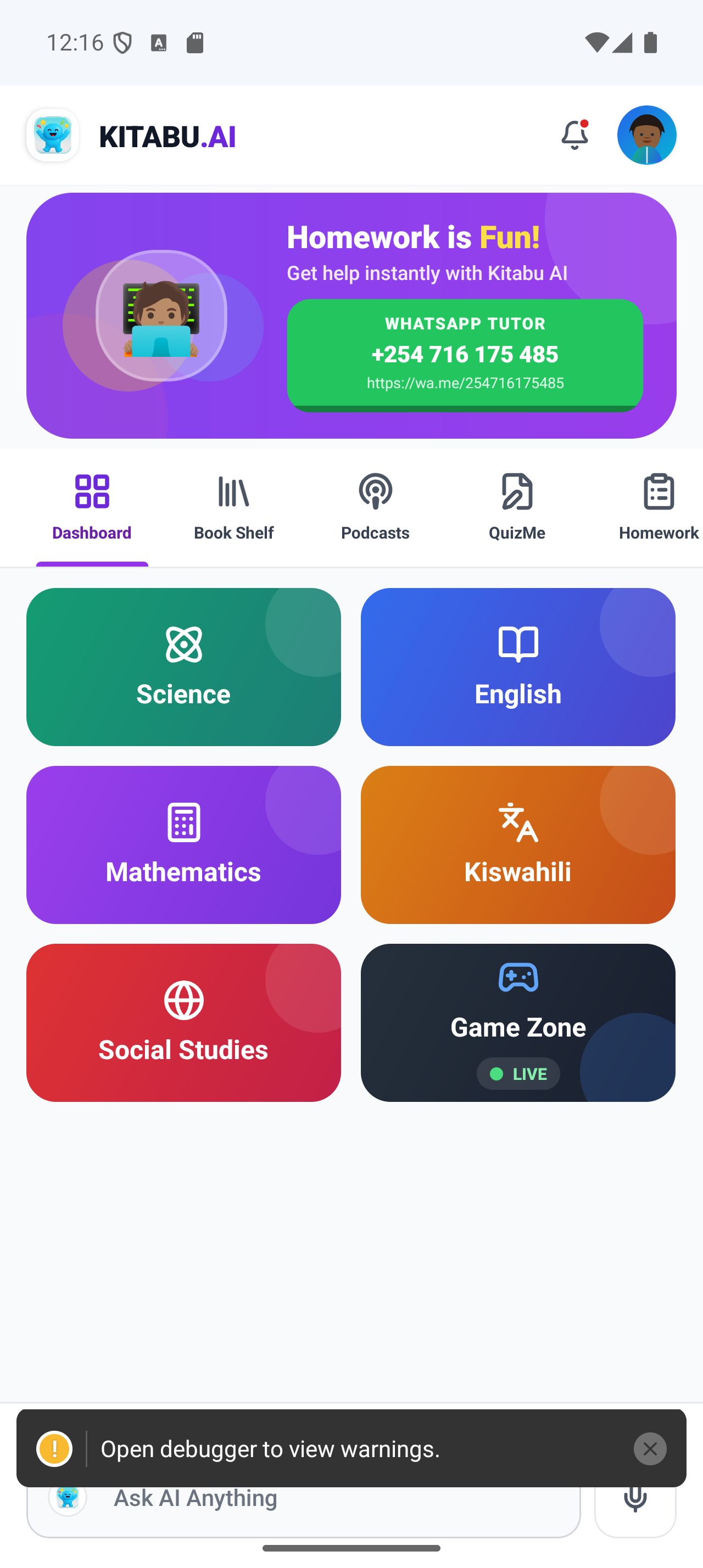
Revision genuinely happens on phones now — and so does everything else. The fix isn’t confiscation; it’s visibility. When revision happens inside a learning app that reports honestly, the phone becomes a witness: what was studied, for how long, which quiz, what improved. Daily dashboard + Friday WhatsApp. No interrogation required.
Related: online homework help Kenya · CBC revision app.
Exam-season and holiday use
The same ritual holds when the calendar gets loud:
- KPSEA / KJSEA / KCSE run-up: keep the five-minute Sunday check; don’t replace it with nightly panics. Guides: KPSEA Grade 6, KJSEA Grade 9.
- Holidays: short daily warmth beats open-ended “revise all day.” See holiday revision Kenya.
Sometimes the worry is the problem
Sometimes the child genuinely is revising, and the parent’s anxiety — not the child’s effort — needs attention. If the weekly ritual keeps turning up an artifact, a confident teach-back, and a topic that is moving, that is real evidence. Trust it. Visibility should build trust both ways — proof for the parent, relief for a child who no longer has to defend an honest evening.
It is worth noticing what happens once this shift is made. A parent who has stopped needing to interrogate has more evenings that are simply calm — no door-knock, no “umesoma?”, no guessing. And a child who no longer has to defend an honest evening tends to volunteer more, not less, because there is nothing left to hide. The goal was never certainty down to the minute; it was removing the guessing game for both of you.
Keep it kind
The goal isn’t catching a child pretending — it’s removing pretending as an option while protecting trust. Swap “umesoma?” for “show me your best question this week.” Celebrate produced work, not hours logged. Whatever Sunday turns up — strong progress, a stalled topic, or a quiet admission that the week slipped — react the same calm way each time. Predictable kindness is what keeps the truth coming next week.
Where Kitabu fits
If revision needs a patient teacher to become worth doing — and you want the phone to testify — Kitabu AI is built for Grades 1–12:
- Dashboard + Friday WhatsApp plain summary
- Android live; iOS/web coming
- 1-month free trial
- KSh 100/month (list 250); termly KSh 250 (list 500); Premium KSh 999/term
- KPSEA / KJSEA / KCSE past papers included from KSh 100/month
Questions: WhatsApp +254 716 175 485 or +254 010 886 5757 · hello@kitabu.ai
Common questions
How many hours should my child revise daily?
No single right number. A short, focused daily habit beats occasional marathons. What matters is evidence — teach-back, quiz, named topic — not elapsed minutes alone.
How do I check my child is revising without spying?
Two-minute teach-back, one artifact, one kind specific question. No reading their messages.
Is revising on a phone real revision?
It can be. The difference isn’t the device — it’s whether the app reports what was studied, for how long, and what improved.
What are the signs my child is not really revising?
Can’t explain back what they “studied,” nothing produced, same topic “hard” for weeks with no movement.
What should I do if I find out they’ve been pretending?
Stay calm and curious. Fear makes better hiding, not better revision. Move to visible tools and a short honest ritual.
Does Kitabu work on iPhone yet?
Android is live today. iOS and web are coming soon.
What’s in the Friday WhatsApp?
A plain-language weekly summary of what was practised and what moved — aligned with how we describe parent progress updates. Specific and true beats vague praise.