Homework
How to help your child with CBC homework without doing it for them
The methods are new, the terms are new, and the worksheet looks nothing like what we studied. Here’s what actually helps — and none of it requires becoming a CBC expert.
Last updated: 6 September 2026
How can I help my child with CBC homework if I don’t understand it?
1. Ask them to show how the teacher did it on the board — don’t teach your old method.
2. Keep a stuck list: two honest tries, then write it down and move on.
3. Use help that explains step by step and checks with practice — never a photo of finished answers.
What “good homework help” means under CBC
Good homework help under CBC (also searched as CBE — Competency Based Education; CBC vs CBE explained in one place) means you guide and protect honest working. You do not complete the sheet. The teacher needs a visible trail of thinking — mistakes included — to see where the class and the child need support. A perfect worksheet the child cannot explain hides the gap until the test.
First, the truth: it’s not you
The CBC teaches differently on purpose. Where we memorised, today’s learners are asked to show working, apply ideas to real situations, and explain their thinking. That’s a better way to learn — and a disorienting thing to supervise when the method on the page isn’t the one you were taught. Almost every Kenyan parent of a Grade 1–12 learner is having this exact evening.
Say it plainly at home: you are not failing your child by not knowing this. The curriculum changed. You didn’t get a manual. What follows is the short manual for tonight’s worksheet, not a teaching certificate.
It also helps to remember what homework is actually for under CBC. It isn’t a grade-collecting exercise handed to a stranger to mark in isolation — it’s meant to be a visible trail of thinking that a teacher can use to see exactly where a class, and a child, need more support. That changes what “good help” looks like. Your job most evenings isn’t to produce a perfect worksheet; it’s to protect an honest one, mistakes included, because an honest mistake is information the teacher can use next week.
Help that teaches vs help that dumps
| Kind of “help” | What the child learns | What the parent sees | Risk at exam / SBA |
|---|---|---|---|
| WhatsApp answer photo | Almost nothing — copy tonight, blank next week | Sheet looks done | Gap returns when wording changes |
| Parent completes the work | That an adult will rescue them | Quiet evening, false calm | Teacher never sees the real stuck point |
| Step-by-step tutor + practice quiz | The method, then proof they can try alone | Pattern of topics over the week | Gaps shrink before the checkpoint |
If you want cheaper calm without stacking tuition every night, the cost angle sits next door on homework help without living at the tutor’s house and the fuller private tuition alternative page — this guide stays on how to help tonight.
Projects vs nightly homework
Not every “homework” battle is the same.
- Nightly maths / English / Kiswahili worksheets need the 20-minute routine below: one subject, stuck list, stop on a win.
- Projects and performance tasks need materials, a clear brief in the child’s own words, and calendar time — not a midnight scramble the night before. Ask the school the deadline early. Don’t invent KNEC project dates from rumour; use the school’s brief.
Mixing the two in one exhausted evening is how both suffer.
What helps (and doesn’t need expertise)
- Ask “show me how your teacher did it” instead of teaching your way. Two competing methods confuse a child. Reconstructing the class method is revision.
- Praise the working, not just the answer. CBC rewards process.
- Shrink the session. Twenty focused minutes beats a two-hour standoff. Stop while it’s still going well.
- Keep a stuck list. Two honest attempts, write it down, move on.
- Never do the homework for them. A finished sheet they can’t explain just hides the gap until exam time.
A worked example: “show me how your teacher did it”
Parent: “I don’t remember fractions being taught like this. Show me how your teacher explained it on the board.”
Child: “She said we draw the whole thing first, then split it into equal parts, then shade the parts we’re using — like a chapati cut into pieces.”
Parent: “Okay, draw that for this question, the way she showed you. I’ll watch.”
Notice what didn’t happen. The parent didn’t import bar models from YouTube or the 1990s method. They asked the child to retrieve the classroom method and perform it out loud. That retrieval is the revision. If the child gets stuck mid-drawing, the stuck point is now precise — worth more than a guessed right answer.
Subject-by-subject quick tips
The “show me how your teacher did it” approach works everywhere, but each subject has a small twist:
- Mathematics: praise the working, not the final answer. Ask to see every step on paper, even the ones that feel obvious to an adult. A wrong answer with clean, visible working is a stronger sign of learning than a correct answer with no working shown. More: when a child is failing maths.
- English and Kiswahili: ask your child to read their answer aloud before calling it finished. Composition and comprehension answers that sound wrong when spoken usually are — awkward phrasing reveals itself in the mouth.
- Integrated Science: connect the concept to something physical in the house. Evaporation is the wet floor drying after mopping; a lever is the bottle opener in the kitchen drawer. CBC science rewards application to real situations.
- Social Studies and Creative Arts: for projects, let your child explain the project brief to you in their own words before they start. If they can’t explain what is being asked, the project will drift off-brief no matter how much effort goes in.
Mistakes to avoid
A handful of habits quietly make homework harder for everyone, even when they come from good intentions:
- Teaching your own method over the classroom method. It feels helpful, but a child now has two competing systems at exam time — and confusion, not clarity, is what tends to show up.
- Letting homework run past the point of learning. An hour past frustration usually erodes what landed in the first twenty minutes, and it teaches a child to dread the subject.
- Treating every wrong answer as a crisis. A worksheet is a snapshot of one evening, not a verdict on ability.
- Comparing siblings or classmates out loud. “Your sister never struggled with this” adds shame, which makes the child less likely to ask for help next time.
The 20-minute evening routine
- Settle. Two minutes: books out, phone away.
- One subject. Due soonest, not favourite.
- Build the stuck list. Two honest tries → write it → move on.
- Stop while it’s going well. End on a win.
- Two-minute teach-back. One thing they’re sure of, in their own words.
When you’re both stuck
This is the moment families usually reach for expensive tuition — or give up. It’s also exactly the gap a patient tutor in the phone can fill: your child asks the question, gets it explained step by step the CBC way, in English or Kiswahili, and can ask again as many times as they need. Then a short practice quiz confirms it landed. If evenings keep snagging on the same subject, our guide to online homework help in Kenya covers what good help looks like — and what answer-dumping looks like, so you can avoid it.
What to do when you are the one who is lost
It is completely normal for a parent to be more lost than the child on a modern CBC worksheet — the methods, vocabulary, and even the subject names have changed since most of us sat exams. The stuck list isn’t only for your child’s benefit; it is for yours too. Write down what confused you as an adult the same way you’d write down what confused your child, and treat both entries the same way: as things to hand to someone who explains patiently, rather than things to feel bad about.
This is precisely where a patient tutor in the phone earns its place — not to replace you, but to be the person who never runs out of patience for a fifth explanation of the same idea, for either of you.
What to do when there’s no adult free at all
Not every household has a parent free at 6 PM, and that is worth planning for honestly rather than feeling guilty about. An older sibling can run the same “show me how your teacher did it” routine just as well as a parent — the technique works because of the question, not because of who is asking it. On evenings when nobody is available at all, the stuck list still does its job alone: a child who writes down exactly where they got stuck has done something more useful than staring at an unsolvable question for twenty minutes. The list becomes the conversation starter for whoever is free next — a parent later that night, a teacher the next morning, or a patient tutor in the phone in the meantime.
Watch the pattern, not the night
One hard evening means nothing. The same topic hard for three weeks means something. Weekly progress signals matter more than any single battle — see is my child really revising and parent progress updates.
When the app helps
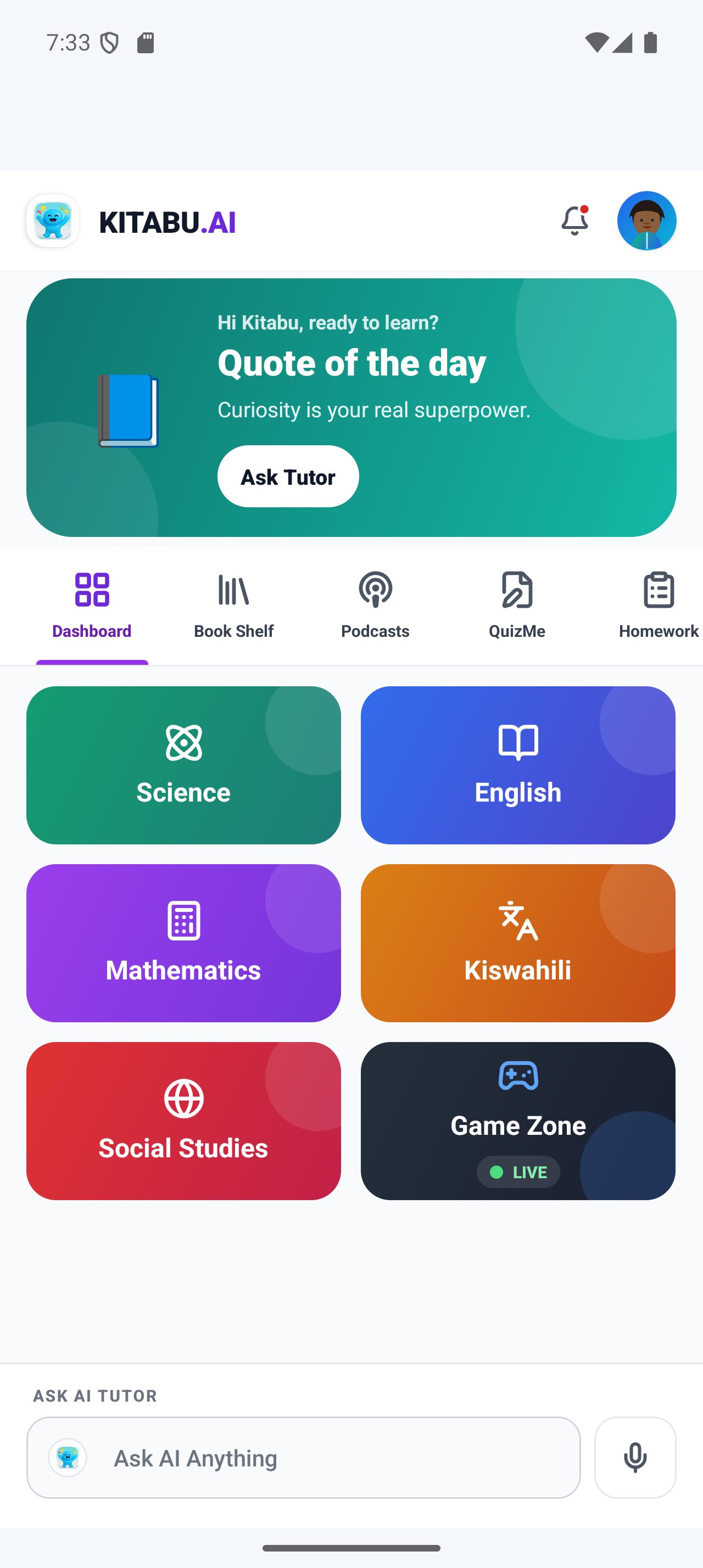
If you want a patient teacher on call for the 8 PM questions — and a Friday WhatsApp that names how the week really went — Kitabu AI is built for that:
- Grades 1–12 · English & Kiswahili
- Explains step by step, then practice — not copy-paste answers
- Parent dashboard + Friday WhatsApp
- Android live (Play Store); iOS/web coming
- 1-month free trial; then KSh 100/month this season (list KSh 250); termly KSh 250 (list KSh 500); Premium KSh 999/term
- KPSEA / KJSEA / KCSE past papers included from KSh 100/month
Start free when you’re ready. Questions: WhatsApp +254 716 175 485 or +254 010 886 5757 · hello@kitabu.ai
Common questions
Do I need to understand CBC to help my child with homework?
No. Ask "show me how your teacher did it" and listen. Protect confidence and habits first.
Is CBC the same as CBE?
Parents search both. CBE (Competency Based Education) is the current official naming for the same competency-based approach most families still call CBC. One clarifying read: CBC vs CBE explained.
How long should homework take in Grade 1 to Grade 12?
It varies by school. A focused twenty-minute session per subject is a reasonable evening target for most learners. Hours every night is worth raising with the teacher.
Should I correct my child’s homework before it’s submitted?
Gently, after they have tried. Point and ask "are you sure about this one?" rather than fixing it yourself.
What if we’re both stuck on the same question?
Write it on the stuck list, move on, and let the teacher or a step-by-step tutor fill the gap later.
Is it okay to use a learning app for homework help?
Yes, if it explains rather than hands over answers — and checks understanding with practice.
Are KPSEA / KJSEA / KCSE past papers included on Kitabu?
Yes, on the KSh 100/month plan (and every plan).